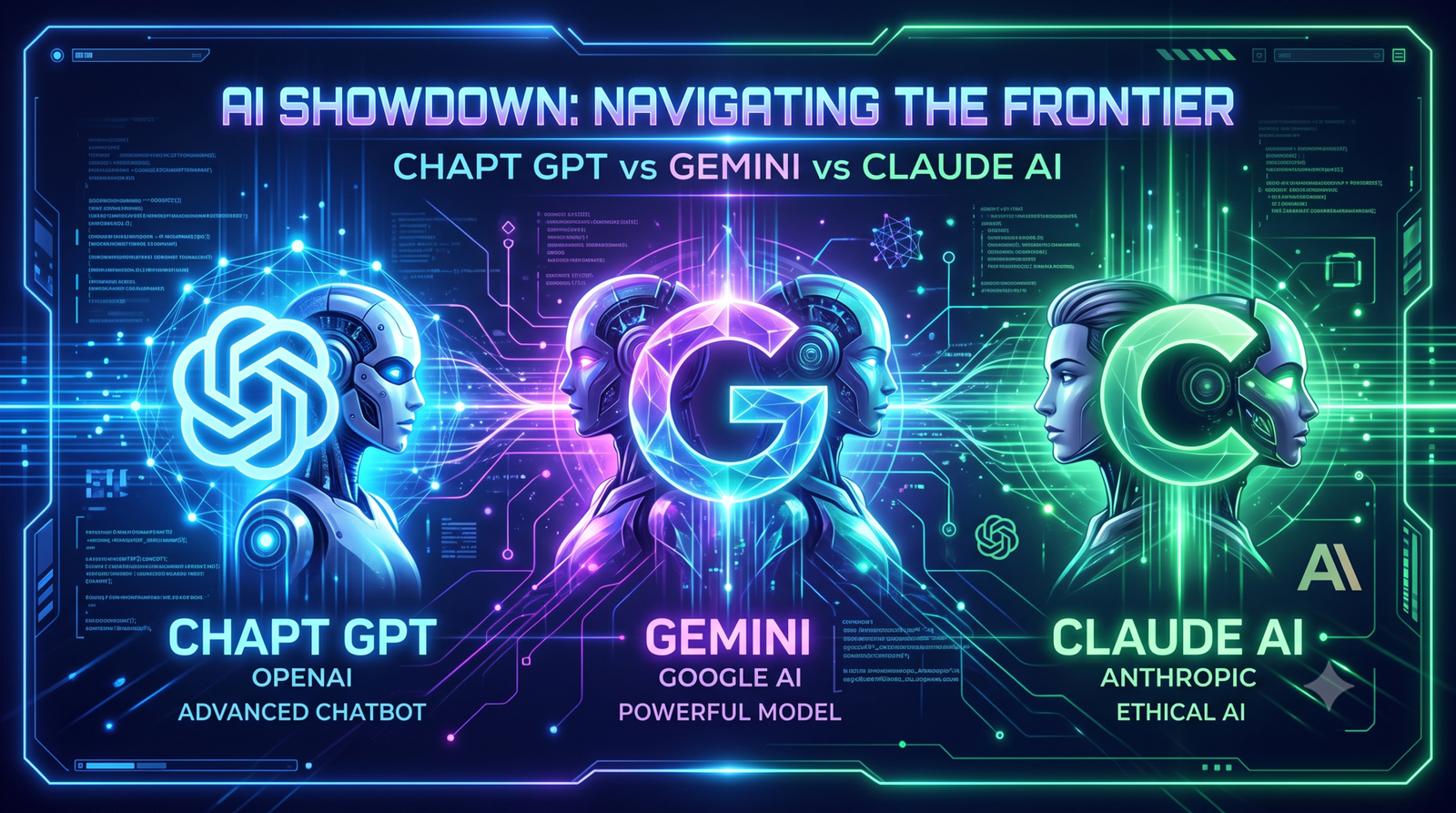
The landscape of AI assistants has transformed dramatically. Three and a half years after ChatGPT first popularized conversational AI, the market is no longer a one-horse race. Today, over a billion people use AI assistants monthly, with ChatGPT commanding 1.1 billion users, Gemini reaching 900 million, and Claude at 245 million. But here’s the thing: ChatGPT’s market share has slipped below 50% for the first time, falling to 46.4% by mid-2026. The AI wars are real, and the question “which is best?” has never been more complicated—or more important.
The short answer? There is no single winner—just different tools for different jobs. ChatGPT leads in versatility, Gemini dominates in Google ecosystem integration, and Claude excels in writing quality and complex reasoning. But let’s dig deeper.
Understanding What We’re Comparing
First, a critical distinction: ChatGPT, Gemini, and Claude are products, not models. Each platform routes requests to different underlying AI models depending on your plan and the task at hand.
- ChatGPT runs on OpenAI’s GPT-5.6 family, with three tiers: Sol (flagship), Terra (balanced), and Luna (fastest and most affordable).
- Gemini leverages Google’s Gemini 3.1 Pro and 3.5 Flash models, with a massive 2 million token context window.
- Claude uses Anthropic’s models including Sonnet 5 (default for most users) and the higher-tier Fable 5 and Mythos 5.
This matters because benchmarks comparing individual models don’t always reflect what you’ll actually experience day-to-day.
The Benchmark Battle: Who’s Actually Smarter?
If you’re chasing pure capability, here’s where the numbers land in 2026:
Claude currently leads in overall capability. According to independent BenchAlign scores, Claude Mythos 5 ranks first overall at 83.85, followed by Claude Fable 5 at 83.6, with GPT-5.6 Sol in third at 79.3. Claude also tops the charts in coding (81.95) and agentic work (77.09).
But benchmarks tell a nuanced story:
| Benchmark | Claude | ChatGPT | Gemini |
|---|---|---|---|
| SWE-Bench Pro (coding) | 69.2% (Opus 4.8) | 58.6% (GPT-5.5) | 54.2% (3.1 Pro) |
| Terminal-Bench 2.1 | 74.6% | 78.2% | — |
| GDPval-AA (knowledge work) | 1890 | 1769 | 1314 |
| GPQA Diamond | — | 94.3% | — |
ChatGPT’s GPT-5.6 Sol leads on ARC-AGI-2 with 92.5% and Terminal-Bench 2.1 with 88.8%. Gemini 3.5 Flash is the “value play”—impressive capability at a lower price point.
The takeaway? At the very top end, Claude and ChatGPT are trading blows. Gemini is catching up fast but generally sits a tier below in raw benchmark performance.
Head-to-Head: Strengths and Weaknesses
ChatGPT: The Versatile All-Rounder
What it does best: ChatGPT is the Swiss Army knife of AI assistants. It combines text generation, web search, live voice, image generation (via DALL-E), file analysis, coding, and long-running agents into one platform. The new ChatGPT Work surface can gather context from connected apps and produce finished documents, slides, sheets, and even web apps.
Key strengths:
- Unmatched versatility—you can do almost everything without leaving the platform
- Strong personalization with memory, custom instructions, and personality settings
- Reasoning slider that lets you control how much “thinking” the model applies to each response
- Free tier now offers unlimited text conversations
Pricing: Free plan with GPT-5.2 (10 messages per 5 hours) + unlimited GPT-4o mini. Paid plans from $8/month (Go) to $20/month (Plus).
Weaknesses: No native video generation (OpenAI sunset Sora 2). The free tier includes ads as of February 2026.
Gemini: The Google Ecosystem Powerhouse
What it does best: If you live in Google Workspace, Gemini is almost impossible to beat. It integrates natively with Gmail, Docs, Drive, YouTube, Chrome, and real-time Google Search.
Key strengths:
- Massive context window—2 million tokens, dwarfing ChatGPT’s 128K
- Multimodal capabilities processing text, images, video, audio, and PDFs
- Gemini Spark—a 24-hour personal AI agent that manages background tasks
- Video generation with Veo 3.1 producing remarkably realistic output
- Generous free tier with 15GB Google Drive storage
Pricing: Free plan with Gemini 2.5 Flash. Paid from $9.99/month (AI Plus) to $20/month (Advanced).
Weaknesses: In comparative testing, Gemini showed the highest variability and lowest success rate in coding challenges, frequently failing to resolve errors even with multiple prompts. Its prose quality is generally considered less nuanced than Claude or ChatGPT.
Claude: The Writing and Reasoning Specialist
What it does best: Claude is the craftsman’s choice—particularly strong for writing, document analysis, and careful coding.
Key strengths:
- Superior prose quality—produces more nuanced, stylistically varied writing
- Massive context—supports 200K tokens standard, 1M on Pro plans
- Artifacts—easy to build, remix, publish, and share interactive mini-apps
- Exceptional coding—Claude consistently outperforms other models, requiring the fewest attempts to generate correct solutions
- “Effort” controls—users can determine how much computational power the model spends on a task
- Strong safety focus—Opus 5 is Anthropic’s best-aligned model yet, with the lowest deceptive behavior rates
Pricing: Free plan with Claude Sonnet 5. Pro plan at $20/month.
Weaknesses: No native image generation. No web search in the free plan. More expensive than competitors at the top end—Claude Fable 5 costs $10/$50 per million input/output tokens.
Practical Use Cases: Which One for You?
Choose ChatGPT if:
- You want one AI that does almost everything
- You need image generation (DALL-E integration)
- You value personalization and conversational naturalness
- You want live voice and real-time web search
- You’re a general user who doesn’t want to switch between tools
Choose Gemini if:
- You live in Google Workspace (Gmail, Docs, Drive)
- You work with enormous documents or datasets (2M token context)
- You need video generation
- You want a proactive AI agent that works in the background
- You prioritize cost-effectiveness—Gemini 3.5 Flash is the value leader
Choose Claude if:
- Your work revolves around writing, editing, and long documents
- You’re a developer doing careful code review and repository work
- You value output quality over feature breadth
- You need privacy and safety-focused AI
- You want the highest capability available (Mythos 5 and Fable 5)
The Verdict
For most people, ChatGPT is the best default in 2026. It’s the most versatile, offers the broadest feature set, and provides a solid experience across virtually every use case.
But specialists should look closer. If your day is mostly text, code review, and long source documents, start with Claude. If you’re embedded in Google’s ecosystem or need massive context and video generation, Gemini has advantages “difficult to ignore”.
The reality is that 81% of enterprises now use three or more AI models. You don’t have to pick just one. The smartest approach in 2026 is to understand each tool’s strengths and use them accordingly—ChatGPT for versatility, Gemini for Google integration, and Claude for writing and careful coding.
The “best” AI isn’t a single answer anymore. It’s whatever fits your workflow, your budget, and your specific needs. And that’s actually great news—because competition is making all three better, faster, and more affordable every single month.