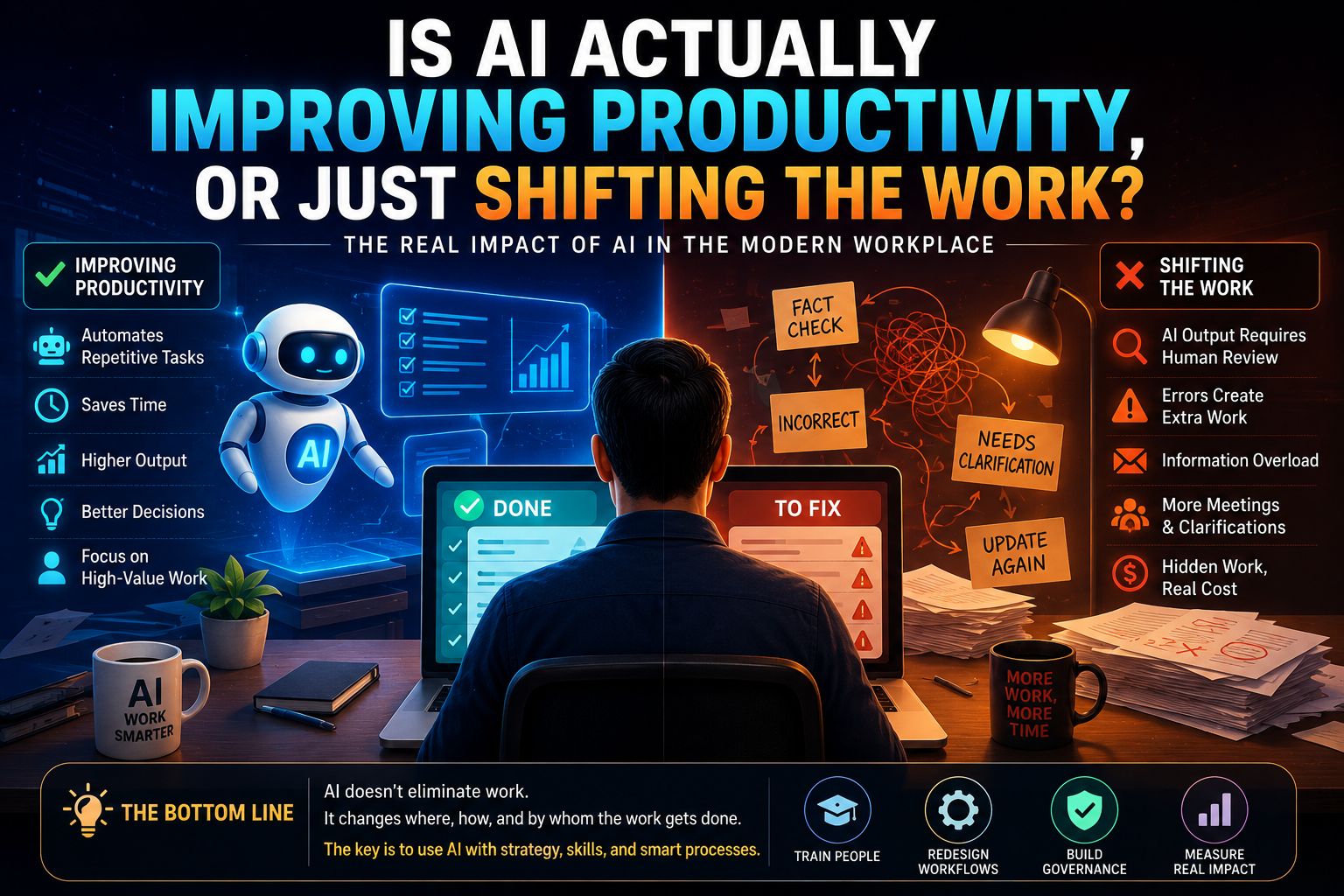
Walk into almost any modern workplace in 2026 and you’ll hear a familiar claim: “AI has made us more productive.”
And in many cases, that’s true.
Employees are using AI to summarize documents, write first drafts, analyze information, review code, answer customer questions, create presentations, and automate repetitive tasks. The result can be a dramatic reduction in the time required to complete certain activities.
But there’s another side to the story.
Some organizations are discovering that the time saved at one stage of a workflow simply reappears somewhere else — in reviewing AI output, correcting mistakes, checking facts, managing risks, or cleaning up work that looked finished but wasn’t.
So, is AI genuinely making us more productive?
The answer is both.
AI is creating real productivity gains for individuals and specific tasks. But those gains don’t automatically translate into better performance for an entire organization.
The Productivity Gains Are Real
The easiest way to understand AI’s impact is to look at what employees are actually experiencing.
McKinsey’s 2026 global State of AI survey found that 80% of respondents said AI had improved their individual productivity, while about half said AI helped them make better decisions. At the same time, only 37% said AI had contributed positively to their organization’s earnings, a figure that remained essentially unchanged from the previous year.
That gap is extremely important.
It tells us that AI can make an employee faster without necessarily making the entire business more profitable.
Imagine a marketing employee who previously spent three hours creating a first draft of a campaign. With AI, that first draft might take 30 minutes.
That’s a genuine productivity improvement.
But if the company still has the same approval process, the same number of meetings, the same reporting requirements, and the same manual publishing workflow, the overall business may not see anything close to a six-fold improvement.
Making one task faster isn’t the same as redesigning the entire process.
And that’s where the AI productivity conversation becomes much more interesting.
Individual Productivity vs. Organizational Productivity
One of the biggest lessons emerging from 2026 research is the difference between individual AI productivity and enterprise-level AI impact.
McKinsey’s latest research describes exactly this gap: employees are becoming more productive with AI, but organizations are struggling to translate those individual gains into comparable financial results.
Why?
Because organizations are systems.
If an employee completes a task faster, that doesn’t necessarily mean the company:
- serves more customers
- generates more revenue
- reduces costs
- improves quality
- makes better decisions
- launches products faster
The rest of the workflow has to change too.
For example:
Before AI:
Research → Writing → Review → Editing → Approval → Publishing
With basic AI adoption:
AI Research → AI Writing → Human Review → Editing → Approval → Publishing
The writing stage becomes faster, but the rest of the process remains largely unchanged.
Now consider a redesigned workflow:
AI-powered workflow:
Automated Research → AI Draft → Automated Quality Checks → Human Review → Automated Publishing → Performance Analysis
That’s a fundamentally different system.
The difference isn’t simply using AI.
It’s redesigning work around what AI makes possible.
The Hidden Problem: Workslop
There’s another reason AI productivity numbers can be misleading.
In 2025, researchers from BetterUp Labs and Stanford’s Social Media Lab introduced the term “workslop.”
Workslop refers to AI-generated work that looks polished and complete but lacks the substance, accuracy, context, or usefulness required to actually move a task forward.
Think about a beautifully formatted report that contains incorrect assumptions.
Or an impressive presentation that doesn’t answer the client’s actual question.
Or an AI-written email that sounds professional but completely misses the context of the conversation.
Or code that works in a simple example but creates problems elsewhere in the application.
The output may look productive.
But someone still has to fix it.
How Big Is the Problem?
BetterUp and Stanford’s research found that around 40% of surveyed U.S. desk workers had received workslop during the previous month. Employees estimated that dealing with each incident required roughly two hours of rework.
That creates an interesting productivity paradox:
AI saves time for the person producing the work, but can create additional work for the person receiving it.
The productivity hasn’t necessarily disappeared.
It has moved.
And sometimes it has moved downstream to someone who isn’t even using AI.
The “Work Shift” Problem
This is perhaps the most important question businesses should ask when measuring AI productivity:
Who is doing the work that AI supposedly eliminated?
Consider a customer-support team.
Before AI, an employee might spend 10 minutes carefully answering a customer.
After AI adoption, an AI assistant generates a response in 30 seconds.
On paper, productivity has improved dramatically.
But what if the AI response is occasionally inaccurate?
The customer may respond again.
A second employee may need to investigate.
A supervisor may need to intervene.
The issue may eventually become a complaint.
The original 10-minute task has now become a 30-second AI-generated response plus several minutes of downstream work.
The AI didn’t necessarily eliminate the work.
It redistributed it.
This doesn’t mean AI is bad.
It means productivity needs to be measured across the entire workflow, rather than at a single step.
Why AI Productivity Gains Don’t Automatically Become Business Results
There are several reasons why this gap exists.
1. Companies Automate Tasks Instead of Redesigning Workflows
Adding an AI tool to an existing process is relatively easy.
Changing the process itself is much harder.
Organizations often start by asking:
“Where can we use AI?”
A better question is:
“If AI can handle this part of the process, how should the entire workflow change?”
The companies getting more value from AI are increasingly focusing on workflow redesign rather than simply adding AI tools to existing processes. McKinsey’s 2026 research emphasizes that individual productivity improvements rarely create lasting enterprise advantage when the organization around those employees remains unchanged.
2. Human Review Still Matters
AI can generate content quickly, but speed isn’t the same as accuracy.
Depending on the task, people may still need to:
- verify facts
- check calculations
- review legal implications
- assess security risks
- confirm customer information
- evaluate recommendations
- approve important decisions
In highly sensitive workflows, human oversight can consume a significant portion of the time that AI initially appears to save.
The goal shouldn’t be to eliminate human involvement at all costs.
The goal should be to move humans toward the parts of the process where human judgment creates the most value.
3. AI Skills Are Unevenly Distributed
Giving everyone access to an AI tool doesn’t mean everyone knows how to use it effectively.
There is a significant difference between:
“I have access to ChatGPT.”
and
“I know how to integrate AI into my workflow, verify its output, automate repetitive steps, and recognize when AI should not be used.”
That difference matters.
Employees need more than access. They need AI literacy, training, clear guidelines, and opportunities to experiment.
4. More AI Usage Doesn’t Automatically Mean More ROI
The latest McKinsey State of AI research shows that organizations are expanding their use of AI, including agentic systems, but the share reporting meaningful enterprise-level financial impact remains much lower than the level of individual productivity improvement.
This is a useful reminder that:
Adoption is not the same as impact.
A company can have thousands of employees using AI and still fail to generate meaningful business value.
Where AI Is Actually Making a Difference
The picture isn’t entirely skeptical.
AI is producing genuine gains in many areas.
Software Development
Developers can use AI to:
- generate code
- explain unfamiliar code
- write tests
- identify bugs
- create documentation
- explore implementation options
Agentic coding tools are also becoming more common. McKinsey’s 2026 research found that around two in ten organizations were scaling software coding agents, with adoption higher among large enterprises.
Customer Support
AI can handle repetitive questions and help agents find information faster.
The important metric isn’t simply:
“How many tickets did AI answer?”
It’s:
“Did customers get better outcomes with less total effort?”
Marketing
AI can accelerate:
- content ideation
- research
- first drafts
- campaign variations
- data analysis
- creative experimentation
But human strategy and brand judgment remain important.
Research and Knowledge Work
AI can dramatically reduce the time required to summarize large amounts of information and identify relevant material.
Again, the human role shifts from producing every piece of information manually toward evaluating, interpreting, and applying it.
The Rise of AI Agents Changes the Question
The productivity conversation becomes even more interesting as AI moves from assistants to agents.
A traditional AI assistant might help you write an email.
An AI agent could potentially:
- Read incoming requests
- Determine what needs to be done
- Gather information
- Take actions in connected systems
- Complete the task
- Report the result
This moves AI from “help me do the work” toward “complete this workflow.”
McKinsey’s 2026 research shows agentic AI adoption continuing to grow, particularly among large organizations. Forty percent of respondents from organizations with more than $1 billion in annual revenue reported scaling AI agents, compared with 27% the previous year.
But agents don’t eliminate the need for process design.
In fact, they make it more important.
The more autonomy an AI system has, the more important it becomes to define:
- permissions
- boundaries
- escalation rules
- monitoring
- quality controls
- accountability
How Companies Should Actually Measure AI Productivity
Instead of asking:
“How much faster is this employee working?”
companies should measure the entire outcome.
Here are some better metrics:
Time Saved
How much human time did AI actually remove?
Quality
Did the quality of the final result improve, stay the same, or decline?
Rework
How much additional effort was required to correct AI-generated output?
Customer Outcomes
Did customer satisfaction, resolution time, retention, or conversion improve?
Financial Impact
Did revenue increase or costs decrease?
Employee Experience
Did AI remove frustrating repetitive work, or did it simply create more monitoring and correction work?
End-to-End Cycle Time
Did the entire business process become faster?
This last metric may be the most important.
Because a 90% improvement in one step means very little if the overall process only becomes 5% faster.
So, Is AI Improving Productivity?
Yes — but not automatically.
AI is clearly improving productivity for many individuals and many specific tasks. Current research strongly supports that conclusion.
But the evidence also shows that individual gains aren’t automatically translating into enterprise-level financial results.
And the rise of workslop demonstrates that poorly managed AI adoption can create new forms of work instead of eliminating them.
So the real question isn’t:
“Does AI make people more productive?”
The better question is:
“Does AI improve the outcome of the entire workflow?”
That’s a much harder question — but it’s also the one businesses should be asking.
The Future of AI Productivity
The organizations that benefit most from AI probably won’t be the ones with the largest number of AI subscriptions.
They’ll be the organizations that figure out how to combine:
AI + People + Processes + Skills + Governance
into a better way of working.
The winning strategy isn’t simply to tell employees:
“Use AI.”
It’s to redesign work so that AI handles what machines are good at while humans focus on judgment, creativity, relationships, accountability, and decisions.
That means:
- Train employees properly
- Redesign workflows
- Measure end-to-end outcomes
- Build review processes
- Reduce unnecessary manual work
- Give AI systems appropriate boundaries
- Track rework and quality
- Reward meaningful business outcomes rather than AI usage alone
Final Takeaway
AI isn’t simply replacing work.
And it isn’t simply creating more work.
It’s changing where the work happens.
For some employees, that means spending less time on repetitive tasks and more time on higher-value activities.
For others, it can mean becoming the person responsible for checking, correcting, and cleaning up AI-generated output.
The difference comes down to implementation.
A company that simply adds AI to existing workflows may get impressive individual productivity numbers without seeing much change in its bottom line.
A company that redesigns its workflows around AI has a much better chance of turning those individual gains into real organizational value.
The productivity revolution is real.
But AI doesn’t create productivity just because you switch it on.
The real advantage comes from knowing what to automate, what to redesign, what to measure, and where humans still add the most value.
And that may be the most important lesson of AI at work in 2026.