Artificial intelligence has evolved rapidly over the past few years. We started with simple chatbots that could answer questions, then moved to powerful AI assistants capable of writing, coding, creating images, analyzing information, and much more.
Now, the next major development is AI agents.
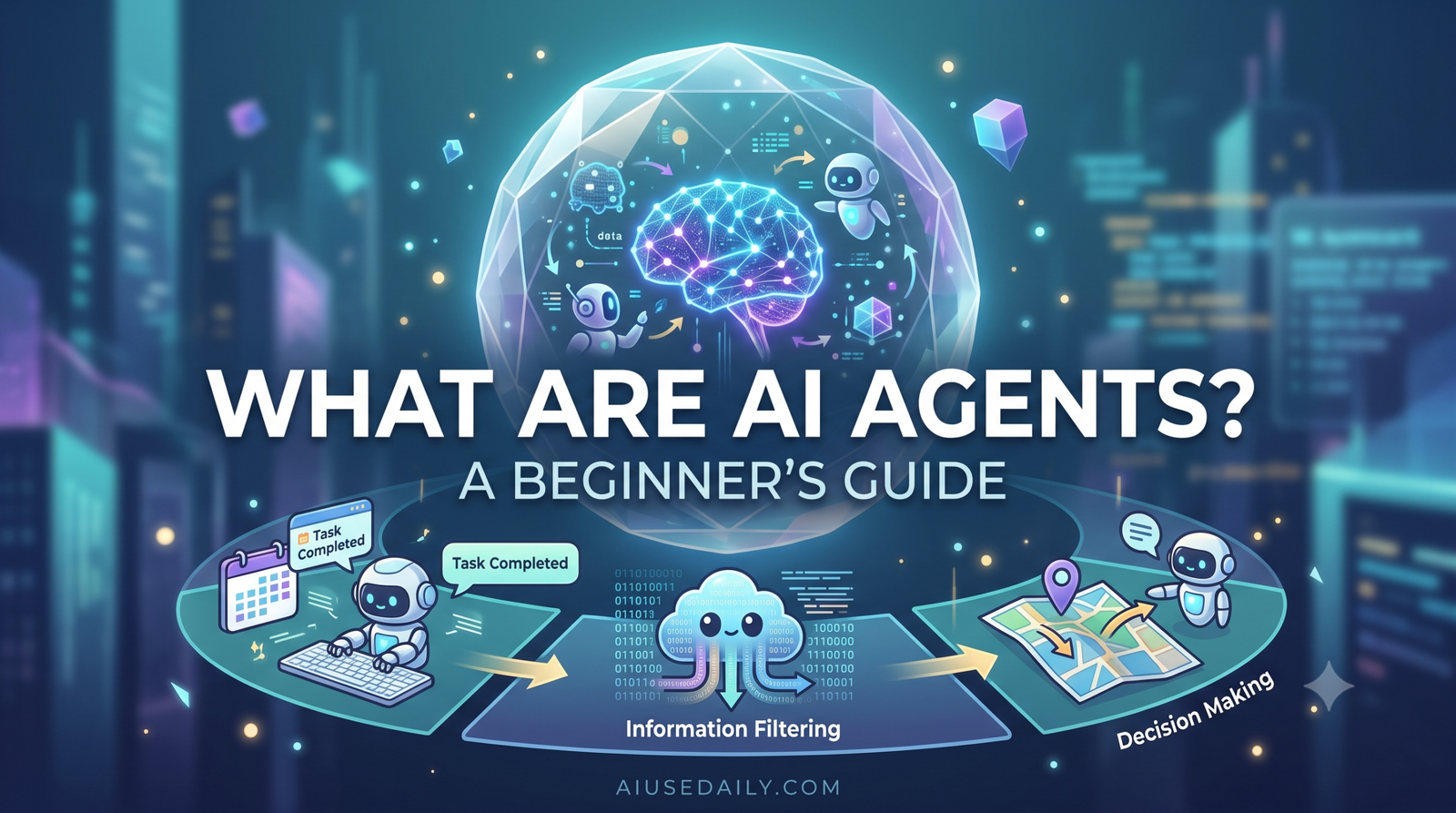
Unlike traditional chatbots that mainly respond to prompts, AI agents are designed to understand goals, make decisions, use tools, and complete tasks with a certain level of independence.
But what exactly are AI agents? How do they work? What can they do? And how are they different from tools such as ChatGPT?
In this beginner’s guide, we’ll explain everything you need to know about AI agents in simple terms.
What Is an AI Agent?
An AI agent is a software system that uses artificial intelligence to understand a goal, make decisions, and take actions to accomplish that goal.
A traditional AI chatbot generally works like this:
You ask → AI answers
An AI agent can work more like this:
You give it a goal → AI plans → AI uses tools → AI performs actions → AI checks the result → AI continues until the task is completed
For example, imagine telling an AI agent:
“Find five affordable hotels in New York for next weekend, compare their prices and ratings, and create a short report.”
Instead of simply telling you how to search for hotels, an agent could potentially:
- Understand your requirements.
- Search available information.
- Compare different options.
- Organize the results.
- Create a report.
- Present the final recommendations.
The important difference is that an AI agent is focused not only on generating an answer, but also on taking actions to achieve an objective.
How Do AI Agents Work?
AI agents typically combine several technologies rather than relying on a single AI model.
A simplified AI agent workflow looks like this:
Goal → Reasoning → Planning → Tool Use → Action → Observation → Decision → Result
Let’s look at these steps.
1. Understanding the Goal
First, the agent needs to understand what the user wants.
For example:
“Find potential customers for my software company.”
The AI needs to understand what “potential customers” means and what information might be useful.
2. Planning
The agent then determines the steps required to accomplish the task.
For example:
- Identify the target industry.
- Search for relevant companies.
- Collect company information.
- Identify decision-makers.
- Organize the information.
- Create a list of prospects.
This planning capability is one of the key differences between a simple chatbot and an agentic system.
3. Using Tools
AI agents can be connected to external tools and systems.
Depending on their design, an agent might interact with:
- Web search
- Databases
- APIs
- Spreadsheets
- Email systems
- Calendar applications
- CRM software
- Coding environments
- File storage
- Business software
This means an agent doesn’t necessarily have to rely only on the information contained within its language model.
4. Taking Action
After deciding what to do, the agent can perform actions using its available tools.
For example, a business agent might:
- Search a database.
- Create a spreadsheet.
- Send an email.
- Update a CRM record.
- Generate a report.
The exact capabilities depend on the permissions and tools given to the agent.
5. Checking the Result
More advanced agents can examine the result of an action and determine what should happen next.
For example, if a search produces poor results, the agent may modify its search strategy.
This creates a feedback loop:
Action → Result → Evaluation → Next Action
That loop is an important part of agentic AI.
AI Agents vs Traditional Chatbots
One of the easiest ways to understand AI agents is to compare them with traditional chatbots.
| Feature | Traditional Chatbot | AI Agent |
|---|---|---|
| Answers questions | Yes | Yes |
| Understands natural language | Yes | Yes |
| Plans multiple steps | Limited | Often |
| Uses external tools | Sometimes | Commonly |
| Takes actions | Limited | Yes |
| Works toward a goal | Limited | Yes |
| Operates autonomously | Usually no | Potentially |
| Handles multi-step tasks | Limited | Stronger |
A chatbot might answer:
“How can I create a marketing campaign?”
An AI agent could potentially help execute the campaign by researching an audience, generating content, organizing tasks, and interacting with connected marketing tools.
However, the distinction isn’t always absolute. Modern AI assistants increasingly include agent-like capabilities, so “chatbot” and “agent” are not always completely separate categories.
AI Agents vs AI Assistants
AI assistant and AI agent are also closely related terms.
An AI assistant generally helps a person complete tasks through interaction.
For example, an AI assistant can:
- Write an email.
- Summarize a document.
- Answer questions.
- Generate ideas.
- Analyze data.
An AI agent generally goes a step further by being able to plan and execute a sequence of actions toward a goal.
Think of it this way:
AI assistant: “Tell me what you want me to do.”
AI agent: “Give me the objective, and I can determine the steps required to accomplish it.”
In practice, many modern AI products combine both approaches.
Real-World Examples of AI Agents
AI agents can potentially be used in many different industries.
1. Customer Support
An AI customer-service agent can handle common customer requests.
It could potentially:
- Understand a customer’s question.
- Search a knowledge base.
- Check an order.
- Provide an answer.
- Create a support ticket.
- Escalate complicated issues to a human.
This can reduce the workload on customer-service teams while allowing humans to focus on more complex cases.
2. Software Development
AI coding agents are becoming increasingly important in software development.
A coding agent could potentially:
- Understand a programming task.
- Inspect an existing codebase.
- Write code.
- Run tests.
- Identify errors.
- Modify the code.
- Repeat the process.
Instead of asking AI to generate a single function, developers can increasingly use agentic systems for larger development workflows.
3. Marketing
Marketing teams can use AI agents for repetitive research and content workflows.
For example, an agent could help:
- Research competitors.
- Identify keywords.
- Analyze customer feedback.
- Generate campaign ideas.
- Prepare social media content.
- Organize marketing data.
Human review is still important, particularly for brand-sensitive or high-impact decisions.
4. Sales
Sales agents can assist with prospect research and lead management.
A system could potentially:
- Identify companies matching specific criteria.
- Research prospects.
- Summarize company information.
- Update CRM records.
- Draft personalized outreach.
- Track follow-up tasks.
5. Personal Productivity
AI agents could eventually act as digital personal assistants capable of handling more complex workflows.
For example:
“Organize my schedule for next week and prioritize my most important tasks.”
An agent could analyze the available information and suggest or perform appropriate actions, depending on the permissions it has.
What Makes AI Agents Different?
Several capabilities make AI agents particularly interesting.
Goal-Oriented Behavior
Instead of responding to individual prompts, agents can be designed around objectives.
Tool Usage
Agents can interact with external software, APIs, databases, and other tools.
Planning
Agents can break complicated objectives into smaller tasks.
Memory and Context
Some agent systems can maintain information about previous interactions or intermediate results.
Adaptability
An agent can potentially change its approach when the first attempt doesn’t produce the desired result.
Automation
Agents can reduce the amount of manual work required for repetitive multi-step processes.
What Are Multi-Agent Systems?
The next step beyond individual AI agents is the concept of multi-agent systems.
Instead of having one AI agent perform every task, several specialized agents can work together.
Imagine an online business with:
- A research agent
- A marketing agent
- A sales agent
- A customer-support agent
- A data-analysis agent
Each agent could have a specific responsibility.
One agent might gather information while another analyzes it. A third agent could turn the results into a report.
This approach resembles a team of digital workers, although the reliability and capabilities of such systems depend heavily on their design, tools, permissions, and human oversight.
Benefits of AI Agents
AI agents could provide several important advantages.
Increased Productivity
Agents can automate repetitive tasks and allow people to spend more time on creative or strategic work.
Faster Execution
A properly configured agent can perform multiple steps without requiring a person to manually initiate every action.
24/7 Availability
Software agents can potentially operate continuously, making them useful for customer support, monitoring, and other always-on workflows.
Scalability
Businesses can use software-based automation to handle larger volumes of repetitive work.
Personalized Experiences
Agents can potentially adapt their actions based on user preferences, available information, and specific goals.
Limitations and Risks of AI Agents
AI agents are powerful, but they are not perfect.
They Can Make Mistakes
An agent may misunderstand a goal, produce incorrect information, or take an inappropriate action.
They Can Produce Unexpected Results
When an agent is allowed to take multiple actions, mistakes can sometimes compound.
Security Is Important
Agents connected to email, databases, financial systems, or business applications can create serious security risks if their permissions aren’t carefully controlled.
Privacy Concerns
Organizations need to understand what information an agent can access and where that information goes.
Human Oversight Still Matters
For important decisions, humans should remain involved. An AI agent should not automatically be trusted with unlimited authority simply because it can perform a task.
A useful principle is:
The more powerful the agent, the more carefully its permissions and safeguards should be designed.
Are AI Agents the Future?
AI agents are widely viewed as an important direction for artificial intelligence.
The reason is simple: people don’t always want AI merely to answer questions. They increasingly want AI systems that can help get things done.
Instead of:
“Tell me how to analyze my sales data.”
The future could look more like:
“Analyze my sales data, identify the biggest problems, create a report, and suggest actions.”
The AI would potentially perform several steps instead of simply explaining them.
However, widespread adoption will depend on improvements in reliability, security, cost, privacy, and integration with existing software.
How to Get Started With AI Agents
If you’re new to the concept, you don’t need to immediately build a complicated autonomous system.
Start with simple workflows.
For example:
Beginner Level
Use an AI assistant to:
- Summarize documents.
- Research topics.
- Generate reports.
- Analyze information.
Intermediate Level
Connect AI to tools such as:
- Spreadsheets
- Databases
- APIs
- Automation platforms
Then create workflows where AI can perform several connected steps.
Advanced Level
Develop specialized AI agents that can:
- Plan tasks.
- Use multiple tools.
- Maintain context.
- Execute workflows.
- Evaluate their results.
- Interact with other agents.
Learning how these systems work now can help you understand where AI automation is heading.
The Future of AI Agents
AI agents could become an important interface between humans and software.
Today, we typically open individual applications to perform different tasks.
Tomorrow, we may simply describe the outcome we want and let an AI system coordinate the necessary applications.
For example:
“Prepare my monthly business report.”
Instead of manually opening multiple applications, downloading data, analyzing spreadsheets, creating charts, and writing a summary, an AI agent could potentially coordinate those steps.
This doesn’t mean humans will disappear from the workflow. In many cases, humans will remain responsible for setting goals, reviewing important decisions, handling exceptions, and ensuring that automated systems behave appropriately.
The most useful future may therefore be humans working alongside AI agents, rather than humans being completely replaced by them.
Final Thoughts
AI agents represent an important evolution in artificial intelligence.
Traditional chatbots primarily focus on conversations and responses. AI agents are designed to go further by understanding goals, planning tasks, using tools, taking actions, and adapting to results.
From software development and customer service to marketing, sales, research, and personal productivity, AI agents have the potential to automate increasingly complex workflows.
However, AI agents also introduce new challenges involving accuracy, security, privacy, and control. As these systems become more capable, responsible deployment and human oversight will become increasingly important.
For anyone interested in the future of technology, AI agents are definitely a technology worth watching.
And this is only the beginning.
AI is moving from systems that simply answer our questions toward systems that can help us accomplish our goals.